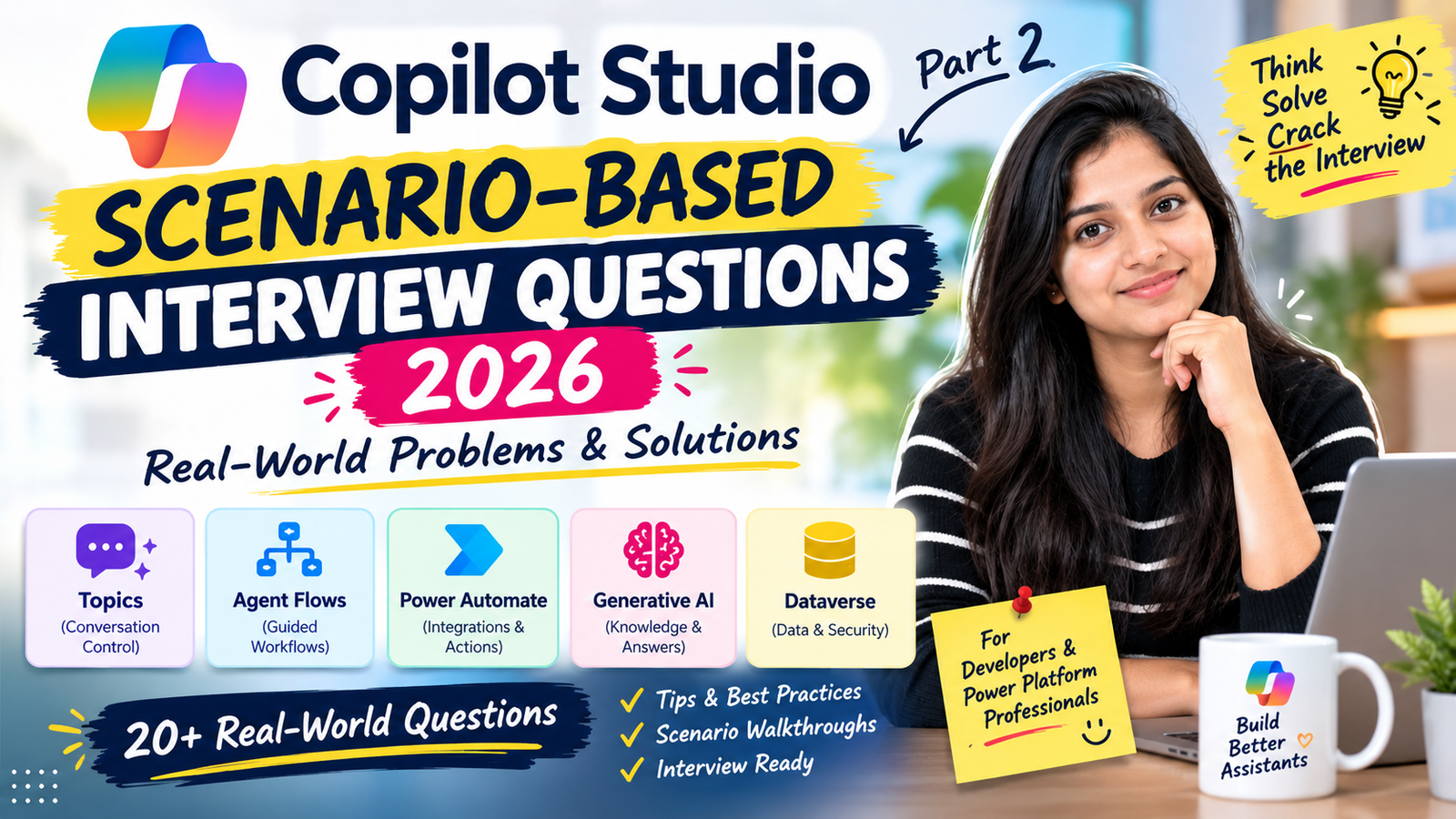
Copilot Studio Scenario-Based Interview Questions
1. Your Copilot needs to retrieve employee leave balance from Dataverse. How would you design this?
I would design this by connecting Microsoft Copilot Studio with Dataverse, typically through an action or Power Automate flow. When the employee asks something like, “How many leaves do I have left?”, the Copilot would identify the authenticated user and pass the required employee information to the flow. The flow would then query the appropriate Dataverse leave or employee table and retrieve the user’s available leave balance.
The important part is that I would not ask the employee to manually enter an employee ID, because that could lead to incorrect or unauthorized data access. Instead, I would use the authenticated user’s identity, such as their Microsoft Entra ID or email, to identify the corresponding employee record. After retrieving the balance, the flow would return the result to Copilot Studio, which would present it conversationally, for example, “You currently have 12 casual leaves remaining.” I would also include proper error handling in case the employee record or leave balance cannot be found.
2. How would you prevent a Copilot agent from exposing another employee’s data?
I would handle this primarily through authentication, authorization, and data-level security, rather than relying only on the Copilot’s instructions. First, I would identify the authenticated user and map that identity to the correct employee record. The user should not be able to simply provide another employee’s email address or employee ID and retrieve their information.
At the Dataverse level, I would configure appropriate security roles, business units, teams, and table permissions based on the organization’s security model. If Power Automate is involved, I would also add validation inside the flow to confirm that the requested record belongs to the current user or that the user has the required permission to access it. For example, if Employee A asks for Employee B’s leave balance, the system should check whether Employee A has permission to access Employee B’s information before returning anything. This creates multiple layers of security and prevents the Copilot from becoming a data-access loophole.
3. When would you use a Topic, Agent Flow, Power Automate Flow, or Generative AI?
I would choose the component based on the type of conversation and business requirement. I would use a Topic when I need to define a specific conversational scenario, such as applying for leave, checking leave balance, or requesting a policy document. Topics are useful when I want more control over the conversation flow.
I would use an Agent Flow when the agent needs to perform an action or execute a business process as part of the conversation. Power Automate is useful when I need to integrate Copilot Studio with systems such as Dataverse, SharePoint, Outlook, Teams, or external services and perform operations like creating, retrieving, or updating records.
For flexible, natural-language questions, I would use generative AI and knowledge sources, especially when the user expects the agent to find and summarize information from enterprise documents or approved knowledge sources. In a real-world implementation, I would usually combine these capabilities—for example, a Topic or generative orchestration can understand the user’s request, an Agent Flow can perform the action, and Power Automate can interact with Dataverse.
4. Your agent has 20+ topics and frequently triggers the wrong topic. How would you fix it?
First, I would analyze the existing topics and check for overlapping trigger phrases, similar descriptions, and duplicate business scenarios. When multiple topics are designed to handle very similar user questions, the agent may have difficulty deciding which one is the best match.
I would make the topic descriptions and trigger phrases more specific and clearly define the responsibility of each topic. For example, instead of having multiple topics with generic descriptions such as “Handle employee requests,” I would define them more clearly, such as “Handle employee requests to check annual leave balance.” I would also test the agent using different variations of the same question, including natural-language and ambiguous queries.
If generative orchestration is being used, I would review the agent’s instructions, available tools, topics, and actions to ensure they are clearly differentiated. I would also remove or consolidate unnecessary duplicate topics. Finally, I would test the changes using a structured set of user questions to make sure the correct topic is consistently selected.

5. How would you handle a Copilot conversation when the user changes their intent midway?
I would design the conversation so that the Copilot can recognize a change in user intent instead of forcing the user to complete the original conversation. For example, the user might initially say, “I want to apply for leave,” but then ask, “Before that, tell me my leave balance.”
In this case, the Copilot should be able to switch to the leave-balance requirement, retrieve the required information, and then continue the leave application if the user still wants to proceed. I would use conversation context, variables, topics, and generative orchestration where appropriate to maintain information that is still relevant.
For example, if the user had already selected a leave type and date, I would avoid asking for those details again after temporarily switching to the leave-balance topic. The goal is to preserve useful context while allowing the user to change direction naturally. This provides a much better conversational experience than forcing users to restart the entire process.
6. How would you handle errors gracefully in a Copilot action?
I would make sure that technical errors are not directly exposed to the end user. For example, if a Power Automate flow fails because Dataverse is temporarily unavailable, I would not display an internal error such as “HTTP 500” or a connector exception to the user.
Instead, I would implement error handling in the flow using appropriate error-handling logic and return a controlled response to Copilot Studio. The Copilot could then respond with something like, “I couldn’t retrieve your leave balance right now. Please try again in a few minutes.”
I would also capture the technical details separately through logging and monitoring, so developers or support teams can investigate the actual issue. Depending on the requirement, I might log the flow run status, error message, correlation information, and affected operation. I would also distinguish between recoverable errors, such as temporary service failures, and business errors, such as “No leave record exists for this employee.” This gives the user a clean experience while still providing enough information for technical troubleshooting.

7. Your Copilot response is taking 10–15 seconds. How would you troubleshoot and improve performance?
I would first identify where the 10–15 second delay is occurring instead of assuming that Copilot Studio itself is responsible. I would analyze the complete request path, including Copilot orchestration, Power Automate flows, Dataverse queries, knowledge searches, API calls, and external connectors.
For example, if a Power Automate flow is making several independent Dataverse or API calls sequentially, I would check whether some operations can be executed in parallel. I would also reduce unnecessary actions and make sure that Dataverse queries return only the required columns and records rather than retrieving a large amount of unnecessary data.
For knowledge-based responses, I would review the knowledge sources and search configuration. For external APIs, I would check their response time and timeout behavior. I would also look at flow run history and other available monitoring information to identify the slowest step.
My approach would be to measure each component individually, identify the bottleneck, and then optimize that specific component. This is much more effective than making random changes to the Copilot configuration.
8. The business wants the Copilot to remember information from previous conversations. How would you approach this requirement?
First, I would clarify what information needs to be remembered, for how long, and for what purpose. I wouldn’t automatically store everything from previous conversations because that could create unnecessary privacy, security, and data-retention concerns.
For information that needs to persist across conversations, I would consider storing the required user-specific information in Dataverse or another approved data store, depending on the organization’s architecture. For example, if the business wants the Copilot to remember an employee’s preferred department or commonly used request type, that information could potentially be stored against the authenticated employee record.
When the user starts a new conversation, the Copilot can identify the authenticated user and retrieve the relevant information. I would also apply appropriate security roles, permissions, data-retention policies, and access controls so that one employee cannot access another employee’s stored information.
I would also distinguish between temporary conversation context and persistent memory. Temporary information may only need to exist during the current conversation, while persistent information should be deliberately stored and governed. So, I would treat memory as an architecture, security, privacy, and data-governance requirement, rather than simply enabling a conversational feature.
✨ Thanks for reading! ✨
I hope you found this blog on the Microsoft Power Platform helpful! From Power Apps, Power Automate (Cloud & Desktop), Canvas Apps, Model-driven Apps, Power BI, Power Pages, SharePoint, Dynamics 365 (D365), Azure, and more, I cover a wide range of topics to help you harness these powerful tools. Don’t miss out on future tips, tutorials, and insights—hit that subscribe button to get the latest posts right to your inbox. 💌
💬 I’d love to hear your thoughts! Drop a comment below with your questions, ideas, or feedback—let’s get the conversation started!
🔗 Let’s connect and grow together!
Follow me, Sanika Thorat, on your favorite platforms for even more content and updates on Microsoft Power Platform and related technologies:
- 💼 LinkedIn – Let’s network and share ideas!
- 💻 GitHub – Explore my projects and code.
- Email Id – thoratsanika98@gmail-com
Let’s build something amazing together with Power Platform and Azure! 🚀
SEO
Copilot Studio Scenario-Based Interview Questions
Copilot Studio Scenario-Based Interview Questions
Copilot Studio Scenario-Based Interview Questions
Copilot Studio Scenario-Based Interview Questions
Copilot Studio Scenario-Based Interview Questions
Copilot Studio Scenario-Based Interview Questions
Copilot Studio Scenario-Based Interview Questions
Copilot Studio Scenario-Based Interview Questions
Copilot Studio Scenario-Based Interview Questions
Copilot Studio Scenario-Based Interview Questions
Copilot Studio Scenario-Based Interview Questions
Copilot Studio Scenario-Based Interview Questions
Copilot Studio Scenario-Based Interview Questions
Copilot Studio Scenario-Based Interview Questions
Copilot Studio Scenario-Based Interview Questions
Copilot Studio Scenario-Based Interview Questions
Copilot Studio Scenario-Based Interview Questions